Module 9. Learning how to learn Age 13+
Study that works
What you can pull out of your head matters more than how long you sit at the desk.
Draft. The BELIEVE team is still checking this page.
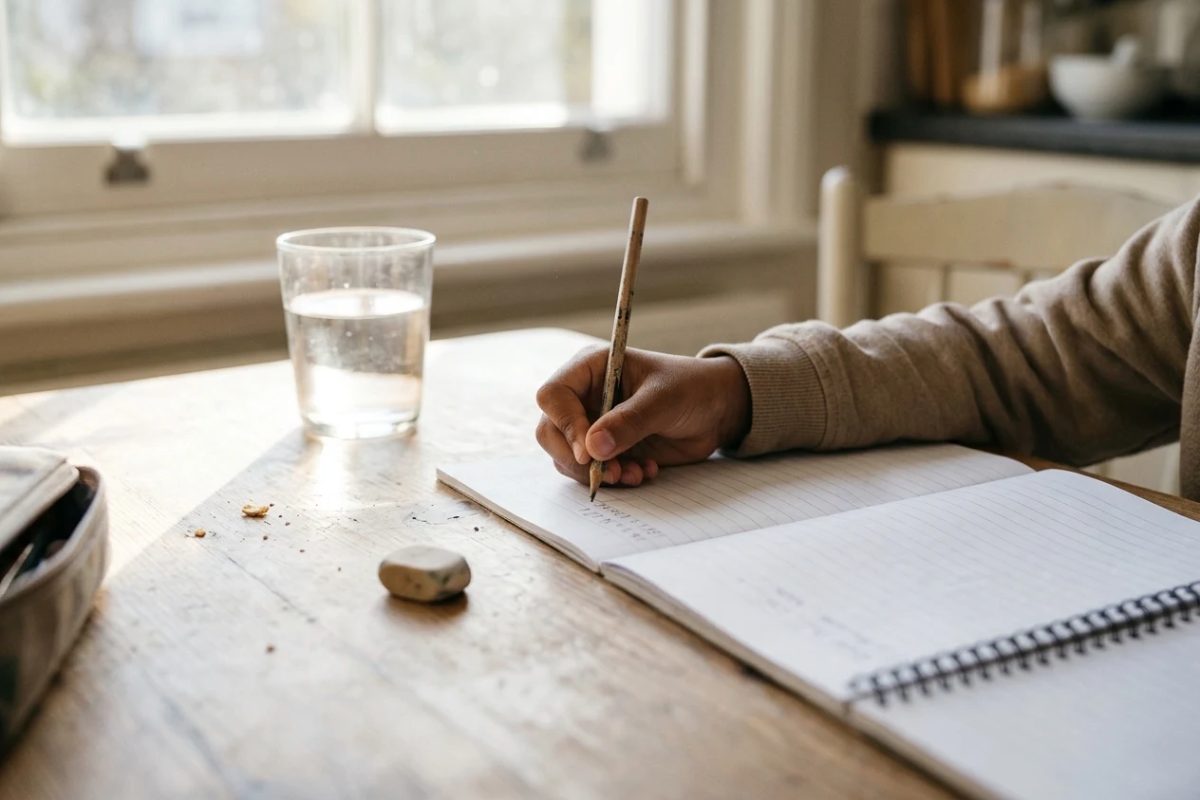
Two friends have the same science test.
The first spends 3 hours on it. She rereads her notes and highlights nearly every line in four colours. She feels like she's worked really hard.
The second spends 40 minutes. He closes the book and writes down everything he can remember. Then he checks what he missed and tries again.
The next day, he does better. That can feel unfair. It's just how memory works.
Why doesn't rereading work very well?
Rereading feels good because the page starts to look familiar. Familiar and remembered are two different things, though. In the test, nobody shows you the page.
Scientists checked 10 popular ways to learn. Rereading, highlighting and summarising all came out near the bottom. Two methods came out top. Testing yourself and spacing your practice out over days.
What goes in and what comes out?
Think of learning in two halves.
What goes in is reading, watching, listening and making notes.
What comes out is answering questions, explaining, writing from memory and solving problems. That's where most of the learning sticks.
In one test, students read a passage. Some reread it. Others tested themselves on it. A week later, the testers remembered 61%. The re-readers remembered 40%.
Which methods work best?
Pick one or two of these to try.
- Blank page. Close everything. Write all you know about a topic. Then check and fill the gaps.
- Space it out. Come back to a topic after a day, then a few days, then a week. A little forgetting in between makes your brain work harder to pull it back. That effort helps it stick.
- Explain it. Teach it to someone, even an imaginary class. In one test, people who expected to teach remembered more.
- Mix it up. Do questions from different topics in one session. You'll have to work out which method each one needs.
How long should a session be?
Try 25 to 30 focused minutes, then a short break. Focus wears down the longer you go. A break lets it fill back up.
Keep your phone in another room if you can. Scientists say switching between tasks can waste up to 40% of your time.
And sleep. Sleep doctors say 13 to 18 year olds need 8 to 10 hours. Enough sleep goes with better learning and memory.
Easy to get wrong
- Counting hours instead of what you can actually recall.
- Spending most of your time making beautiful notes. That's all going in and nothing coming out.
- Pulling a late night before a test. Sleep helps your brain hold on to what you learned.
Everyone starts from a different place
Some people have a quiet desk. Others revise at a kitchen table, on a bus or in a shared room. Some have extra time or other support in exams, and the rules on that differ by country and school. That's all fine.
These methods are free and work anywhere. If a full session feels like too much, start with one blank page for 10 minutes. Check it. That's a real session.
Questions you might have
Is highlighting useless?
Not useless, but it's a weak way to learn on its own. Scientists rated 10 popular methods. Highlighting and rereading came near the bottom. Testing yourself and spacing practice out came top.
How much better is testing yourself?
A lot. In one test, students who tested themselves remembered 61% of a passage a week later. Students who only reread it remembered 40%. Same time spent, very different result.
How far apart should I space my revision?
There's no perfect gap for everyone. A simple plan works well. Come back after a day, then after a few days, then after a week. Scientists rate spacing as one of the two best methods.
Does explaining it to someone really help?
It seems to. In one test, people who expected to teach a passage remembered more than people expecting a test. They were especially good at the main points.
Can I revise with my phone nearby?
You can, but it may cost you. Switching between tasks can waste up to 40% of your time, say scientists. Putting the phone in another room removes the temptation to check.
Does sleep really matter that much?
Yes. Sleep doctors say 13 to 18 year olds need 8 to 10 hours. They link enough sleep with better attention, learning and memory. A late night of cramming can undo good work.
Related topics
Remembering things · Tests and revising · Paying attention · Getting organised · Using AI to learn
Collect the Effort every day cards8 cards for this rule. Tap, try it, collect it.See the cardsSources
- Dunlosky and others, "Improving students' learning with effective learning techniques: promising directions from cognitive and educational psychology", Psychological Science in the Public Interest, 2013
- Roediger and Karpicke, "Test-enhanced learning: taking memory tests improves long-term retention", Psychological Science, 2006
- Nestojko and others, "Expecting to teach enhances learning and organization of knowledge in free recall of text passages", Memory & Cognition, 2014
- American Psychological Association, "Multitasking: switching costs", March 2006
- Paruthi and others, "Recommended amount of sleep for pediatric populations: a consensus statement of the American Academy of Sleep Medicine", Journal of Clinical Sleep Medicine, 2016
This is part of Effort every day, one of the 7 BELIEVE rules. Article 102 of 191.