Module 11. Doing things for yourself All ages
Getting yourself ready
A bit of getting ready the night before makes the morning easy.
Draft. The BELIEVE team is still checking this page.
It's 8 o'clock. One shoe is by the door. The other one has gone.
Your PE kit is still in the wash. Your reading book is under the sofa. Someone is shouting "We're going to be late!"
You run out the door with toast in your hand and your coat half on.
Sound like your house? Lots of mornings go like that. Here's how to make them calmer.
Why is the morning such a rush?
Because there are lots of small jobs and not much time. Get up, wash, dress, eat, pack, go. Each one is easy. All of them at once is hard.
The trick is to move some jobs to the night before. Night-time you has more time than morning you.
What can I do the night before?
Pick one of these.
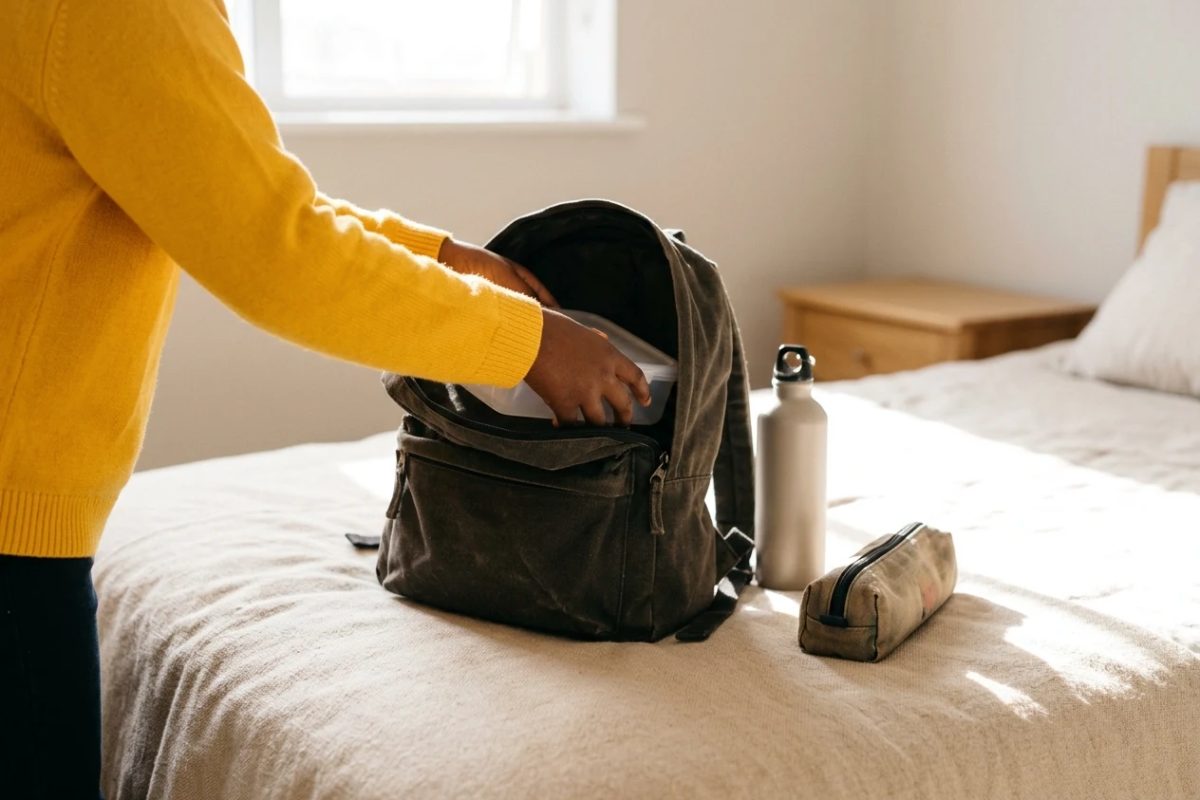
- Pack your bag. Check what day it is tomorrow. Put in what you need. Leave the bag by the door.
- Lay out your clothes. Both shoes too.
- Make a list. Write the things you need each day. Stick it where you'll see it.
- Go to bed on time. A tired brain forgets things.
Do lists really help?
Yes. Your brain can only hold a few things at once. A list holds the rest for you. Even doctors use them. Some hospitals tried a short checklist before each operation. Fewer people got ill after.
Your list can be tiny. Bag. Water. Lunch. Keys. Done.
What if I'm still late?
It happens. Buses are late. Little brothers spill cereal. Nobody gets it right every day.
Look at what slowed you down. Then fix that one thing. Maybe it's the shoes. Maybe it's the phone. Maybe it's the snooze button.
Easy to get wrong
- Packing in the morning. That's when things get left behind.
- Doing it all for a week, then stopping. A habit takes time to stick. Each time you repeat it, it gets more automatic. In the end you do it without thinking.
- Getting cross with yourself. Be kind. Just try again tomorrow.
Everyone starts from a different place
Some homes are calm in the morning. Some are busy and loud. Some people share a room, or move between two homes. Some get themselves up with no grown-up around. All of that is real.
If a full plan feels too much, start smaller. Put your shoes in the same spot every night. Then you never have to hunt for them. That one thing can save 5 minutes.
Questions you might have
How long does it take to make a habit?
Longer than you might think. In one test, it took people about 66 days on average. So keep going for a couple of months. It gets easier every week.
What if I forget one day?
That's fine. In the same habit test, missing one day didn't spoil it. The people who did it most days still made the habit stick. Just carry on the next day.
Do lists really work?
They can. In one test, 8 hospitals used a short checklist before operations. Deaths after operations fell from about 1.5 in 100 to 0.8 in 100. A list helps busy people remember.
How much sleep do I need?
Doctors say people aged 6 to 12 need 9 to 12 hours a night. People aged 13 to 18 need 8 to 10 hours. A good night's sleep makes mornings much easier.
Can I just get up earlier?
You could. Going to bed a bit earlier too helps. Getting up early after a late night leaves you tired. Sleep experts say sleep works best when it's regular.
What should go on my list?
Whatever you forget most. For lots of people it's a coat, a water bottle, a book, a snack or a kit. Keep it short. 5 things is plenty.
Related topics
Getting organised · Being on time and keeping your word · Sleep · Looking after your things and your room · Planning your own week
Collect the Effort every day cards8 cards for this rule. Tap, try it, collect it.See the cardsSources
- Lally and others, "How are habits formed: modelling habit formation in the real world", European Journal of Social Psychology, 2010 (online 2009), summarised in UCL, "How long does it take to form a habit?", 2009
- Haynes and others, "A surgical safety checklist to reduce morbidity and mortality in a global population", New England Journal of Medicine, 2009, summarised in Harvard Gazette, "Surgical safety checklist drops deaths and complications by more than one-third", 2009
- Paruthi and others, "Recommended amount of sleep for pediatric populations: a consensus statement of the American Academy of Sleep Medicine", Journal of Clinical Sleep Medicine, 2016
- CDC, "About Sleep", checked November 2026, for a regular bedtime
This is part of Effort every day, one of the 7 BELIEVE rules. Article 115 of 191.