Module 4. Manners and kindness All ages
Table manners and eating out
Good table manners help everyone enjoy the meal, you included.
Draft. The BELIEVE team is still checking this page.
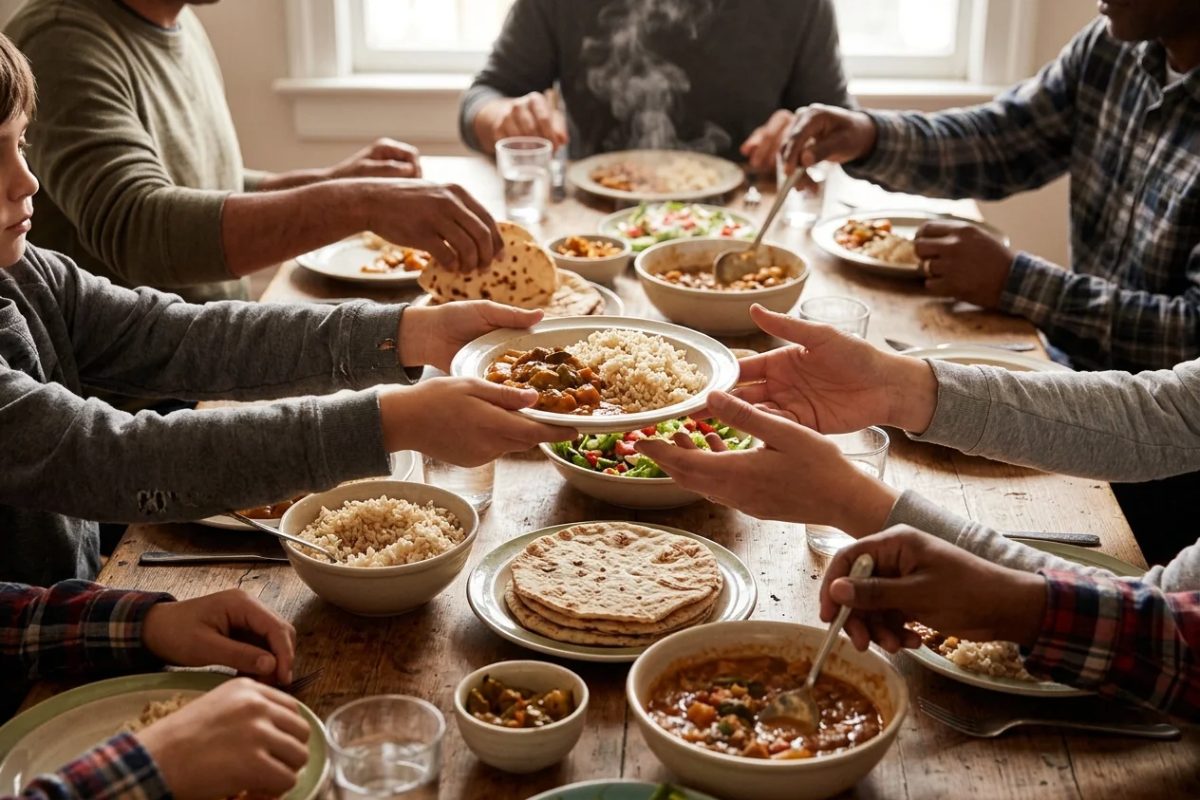
It's someone's birthday. Ten of you squash round a long table at a cafe.
The food arrives. One person grabs the biggest slice of pizza before anyone else gets a plate. Someone else talks with a mouthful of cheese. You can see it all.
Nobody says anything. But everybody notices.
Table manners are just small ways of making a meal nice for everyone. Here are the main ones.
Why do table manners even matter?
Eating is one of the most shared things people do. Families, friends and teams all eat together. Small manners help it feel calm and fair.
They're also different all over the world. Some people eat with a knife and fork. Some use chopsticks. Some eat with their right hand. All of these are polite in the right place.
What are the basics?
Pick these up and you'll be fine nearly anywhere.
- Wash your hands first. It keeps tummy bugs away.
- Wait. Start when everyone has food, or when the host says go. That way nobody is left watching others eat.
- Chew with your mouth shut. Talk once you've swallowed. Nobody enjoys seeing food halfway chewed.
- Ask, don't reach. "Can you pass the water, please?" Reaching across can knock over drinks.
How do I use a knife and fork?
If you use them, the usual way is fork in your left hand and knife in your right. Cut one bite at a time. Rest them on the plate between bites.
When you've finished, put them side by side on the plate. In many places, that tells the staff you're done. Rules differ by country, so watch what others do.
What about eating out?
Look at the person. Say please. "Can I have the pasta, please?" If you're not sure what something is, just ask. Staff get asked all the time.
When the food comes, say thank you. When you leave, say thank you again. It costs nothing and staff notice.
Easy to get wrong
- Phones on the table. They pull you away from the people you're with.
- Saying "yuck" about food. Try "no thanks" instead. Someone made it.
- Leaving the table without asking. A quick "Can I get down, please?" works at home.
Everyone starts from a different place
Some homes eat at a table. Some eat on the sofa, on the floor or at different times. Some families rarely eat out. Some people can't eat certain foods because of their health or beliefs. All of that is normal.
You don't need a cafe to practise. Try one manner at your next meal at home or school.
Questions you might have
Does washing my hands really help?
Yes. Health experts in the US say teaching handwashing cuts tummy bugs by up to 4 in 10. It cuts colds by about 1 in 5. Use soap and water.
Why do phones at the table matter?
In one test, more than 300 people ate out with friends or family. When phones were on the table, people felt more distracted. They enjoyed the meal less too.
Is it rude to eat with my hands?
Not always. In many countries, eating with your hand is the normal way. Some foods, like pizza or sandwiches, are eaten with hands almost everywhere. Watch what others do.
Should I talk to the waiter?
Yes, kindly. In one test, coffee shop customers who smiled and chatted for a moment felt happier afterwards. They felt more like they belonged too.
What if I don't like the food?
Leave it quietly or say "no thanks". You could try one small bite first. Someone worked hard to make it.
Do I have to tip?
That's for the grown-up paying. Tipping rules differ a lot by country. In some places it's expected. In others people rarely do it.
Related topics
Please, thank you and sorry · Being a good guest and a good host · Phone manners · First things to cook · Food and water
Collect the Everyone counts cards8 cards for this rule. Tap, try it, collect it.See the cardsSources
- CDC, "Handwashing facts", checked November 2026
- Dwyer, Kushlev and Dunn, "Smartphone use undermines enjoyment of face-to-face social interactions", Journal of Experimental Social Psychology, 2018, with a summary by UBC Psychology, "Not enjoying your dinner out? Try putting the phone away", February 2018
- Sandstrom and Dunn, "Is efficiency overrated? Minimal social interactions lead to belonging and positive affect", Social Psychological and Personality Science, 2014
This is part of Everyone counts, one of the 7 BELIEVE rules. Article 41 of 191.