Module 10. Money All ages
What money is
Money is something everyone agrees to swap. That's where its power comes from.
Draft. The BELIEVE team is still checking this page.
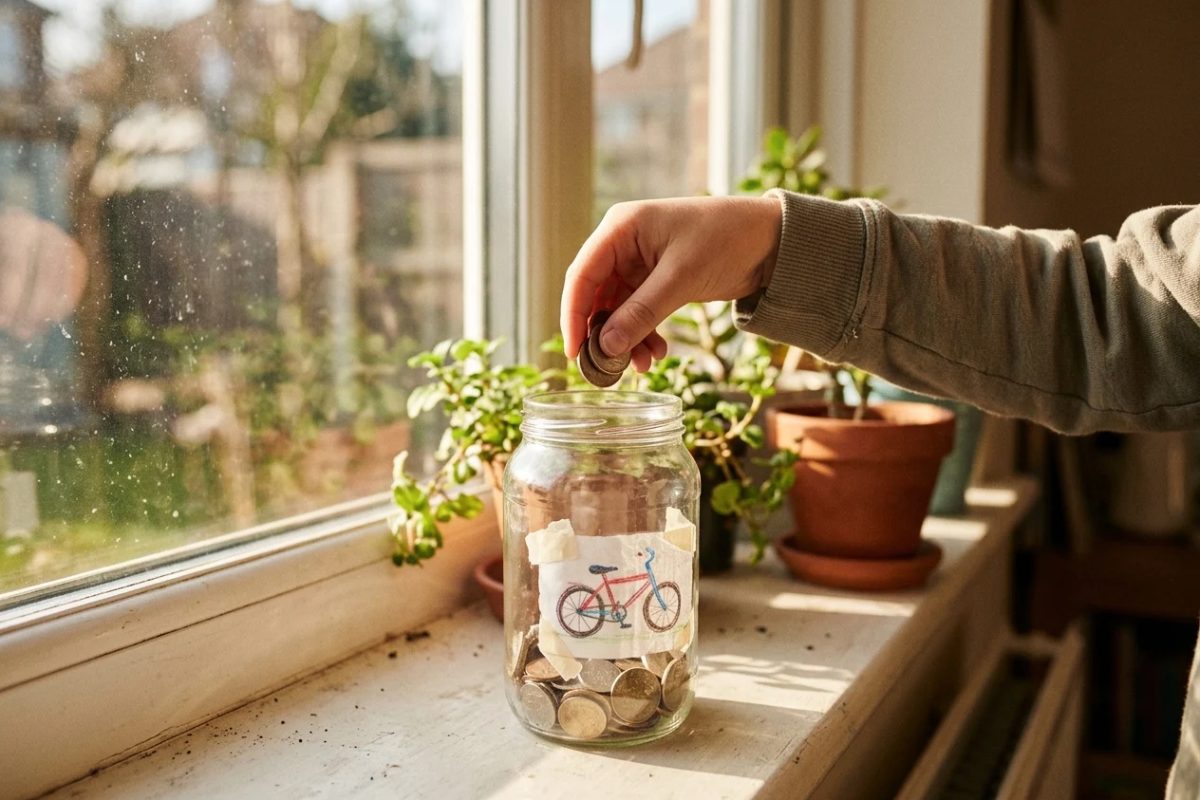
You've got a shiny marble. Your friend has a cool sticker. You both want to swap. Easy.
Now say you want a loaf of bread. The baker doesn't want your marble. Now what?
That's the problem money fixes. Everyone agrees it's worth something. So you can swap it for nearly anything.
Where did money come from?
Long ago, people used all sorts of things as money. Cows, grain and lumps of metal all did the job.
Then, more than 2,600 years ago, people in a land called Lydia had an idea. They stamped little lumps of gold and silver mixed together. Those were the first coins.
Paper notes came later. Now most money is just numbers kept on computers.
Is money only coins and notes?
Not anymore. In the UK, for example, only about 3 in every 100 units of money are notes and coins. The rest is mostly numbers kept by banks.
When a grown-up taps a card or a phone, real money moves. It just moves as numbers.
Why do things cost what they do?
Lots of things go into a price. Someone made it. Someone moved it to the shop. Someone works at the till. They all get paid.
Then there's how many people want it. When lots of people want something and there isn't much of it, the price goes up. When there's loads of it, the price often drops.
So what makes money worth anything?
Trust. A note is only a bit of paper or plastic. It works because everyone agrees it's worth something. If people stopped trusting it, it would stop working.
Easy to get wrong
- Thinking a card or a phone is free money. Every tap takes real money from somewhere.
- Thinking a high price means it's better. Sometimes it's only rare, or the name on it costs extra.
- Thinking money is the same everywhere. Countries have their own money, and prices are different too.
Everyone starts from a different place
Some homes have plenty of money. Some have very little. Some families talk about money all the time. Some never do. None of that says anything about who you are.
If money feels like a big topic, start small. Next time you see a price, have a guess at why it costs that much.
Questions you might have
Who makes money?
In most countries, a central bank or the government makes the notes and coins. Ordinary banks make the rest when they lend. In the UK, about 80 in every 100 units of money start that way.
What were the first coins made of?
A natural mix of gold and silver called electrum. Lydia is now part of Turkey. People there made the first coins over 2,600 years ago.
Why do prices go up when something is rare?
People want things more when there aren't many left. In one test, cookies came from a jar of 2 or a jar of 10. The cookies from the jar of 2 got better scores.
When do people start to understand money?
Quite early. Experts in Cambridge found that by about age 7, most people can count money. They also know it can be swapped for things. You're already ahead.
Why can't a country just make loads more money?
Say there's lots more money but the same number of things to buy. Then each bit of money buys less. So prices go up. Money only works when there's the right amount of it.
Does every country use the same money?
No. Most countries have their own, like the yen in Japan or the rupee in India. Some share one. Lots of countries in Europe use the euro. Prices change from place to place too.
Related topics
Needs and wants · Pocket money · Saving up for something · How the world works · Is it true?
Collect the Effort every day cards8 cards for this rule. Tap, try it, collect it.See the cardsSources
- Kroll, "The coins of Sardis", in The Lydians and their World, Archaeological Exploration of Sardis, 2010
- Bank of England, "How is money created?", checked November 2026
- Worchel, Lee and Adewole, "Effects of supply and demand on ratings of object value", Journal of Personality and Social Psychology, 1975
- Whitebread and Bingham, "Habit formation and learning in young children", University of Cambridge for the Money Advice Service, May 2013
This is part of Effort every day, one of the 7 BELIEVE rules. Article 104 of 191.